
Curious Capitalist

Davos Wisdom, 2013: Five Lessons from the Global Forum

  • Share
  • Read Later
Ratcliffe / Bloomberg / Getty Images

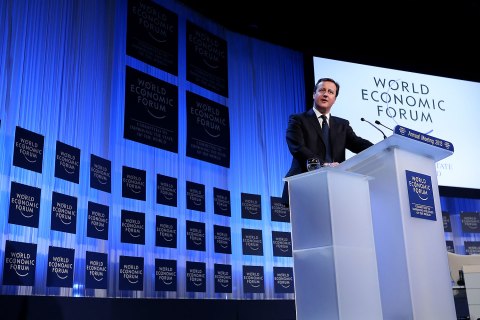
David Cameron, U.K. prime minister, speaks during a session on day two of the World Economic Forum (WEF) in Davos, Switzerland, Jan. 24, 2013.

One of the best descriptions of Davos I ever heard originated with my friend David Rothkopf, the CEO of Foreign Policy, whose book “Superclass” is perhaps the definitive chronicle of Davos man. “Davos,” he says, “is a factory in which the conventional wisdom is manufactured.” If that’s true, it’s worth knowing what was churned out of the factory this week as the World Economic Forum Annual Meeting wraps up today. Here’s my top 5 CW list:

(MOREDavos Crib Sheet: Top Global Risks of 2013)

  • We are entering very risky territory in terms of how much central bankers are doing, in lieu of real political action, to try and boost economic growth. Nobody, with the exception of a few worried Germans, was talking about this last year. Now, everyone is fretting about how the Fed, the ECB (until recently), the Bank of Japan and even the Chinese authorities have distorted asset prices of everything from stocks to bonds to real estate, quite possibly laying the foundation for the next crisis. For more on how all this works, check out my Curious Capitalist column from September 24th, 2012 entitled “The S & P Soars, the Economy Snores.”  Yes, I feel validated, as I’ve been writing this story for some time, but on the other hand, it’s not exactly the sort of thing you want to be right about.
  • Currency wars have become a real possibility. Just as central bankers are keeping interest rates low and asset prices high, so does every country wants to keep its currency down in order to make exports more competitive. Again, I’ve been predicting this for some time; check out my 2011 column on the topic here. The thing is that currency wars create a race to the bottom that can derail the global economy. Hedge fund titan George Soros speculated this week in Davos that we’ll see Germany, the growth engine of Europe, start to slow down in 2013 as a weaker yen props up Japanese exports at the expense of German ones. That could throw the Eurozone, which has begun to stabilize a bit, back into crisis.

(MORE: The TIME at Davos Debate: The Rewards of Mastering Risk)

  • Five years on from the sub-prime crisis, the financial system is still just as risky and unregulated as it ever was (one of the highlights of this week has been watching JP Morgan head Jamie Dimon fend off more attacks from hedge funder Paul Singer on this score). Banks still aren’t lending. What’s new is that in lieu of banks actually reconnecting themselves to the real economy, fresh players are starting to move into lending; emerging market sovereign wealth funds are loaning money for infrastructure projects worldwide, and peer-to-peer lenders are now loaning hundreds of millions to small businesses in the UK (new rules coming soon in the US may allow them to take off here too). The message to banks: if you don’t lend, others will, ultimately disrupting your business model.
  • Big rich multinational companies are increasingly at odds with their home countries over things like taxes, job creation, and social welfare. Nations are finally pressuring rich firms to pick up some of the costs of globalization, rather than just the benefits. I mentioned this as a possible future trend in my Davos wrap column last year and this year it’s really happening. UK prime minister David Cameron gave a very powerful speech on this front, saying that as the UK takes over the G8, he would name and shame multinationals that use creative accounting to avoid taxes (he had a funny “wake up and smell the coffee” reference to Starbucks, which was recently put under fire for paying only a few million in taxes on billions of UK revenue in the last 14 years, and has now coughed up double what they owe for the last year as a result). There is also increasing talk about industrial policy, and favoring domestic firms, which is increasingly seen as smart self-interest rather than protectionism. That will have big trade and labor ramifications.

(MORE: Is the Scene At Davos Getting Old?)

  • Jobs are a problem, but politicians still don’t have the answers. Despite the fact that hundreds of millions of people are still unemployed or under-employed following the 2008 crisis, jobs tend to be the after-thought at the end of many political speeches here in Davos.  Companies are actually talking more constructively about jobs and the skills gap than politicians are, and some of the big blue chips are actually beginning to get into the education game themselves, partnering with community colleges or setting up schools in the developing world. Given how beleaguered public budgets are, I think that corporate involvement in education is something we’re going to see more and more of, possibly in the form of the kind of partnerships I wrote about here.

One final point that’s worth mentioning is that there’s a big gap between Davos man and the rest of us. Every year here on the Magic Mountain, the PR firm Edelman unveils their multinational survey of public trust in various institutions (like government, business, media, non-profits) called the “Trust Barometer.” One of the most interesting findings this year is that there’s a big gap in trust between the elites and the common man – the former has a lot more faith in public institutions of all kinds that Mr. Main Street does. That’s perhaps the biggest conventional wisdom takeaway of all, and one that the world leaders gathered here should keep very much in mind.

MORE: Davos: Why U.S. Companies Fail to Innovate

6 comments
CarlLegg
CarlLegg

"One of the most interesting findings this year is that there’s a big gap in trust between the elites and the common man."

"Lack of trust" is a polite way to put it. Outrage and disgust is what most people feel. The "elite" business and political leaders at Davos, who flew in on their private jets, are the ones who engineered and sanctioned the economic meltdown that has financially devastated millions of workers.

The wealthiest, and often greediest -- like Moynihan, Dimon, and Paulson who profited handsomely from the economic meltdown that they engineered -- are now warning the 99.9% that "wealth disparity" is the #1 global risk. I can't recall a more galling example of hubris and duplicity rolled into one. Many of these "leaders" are little more than sociopaths of excessive greed. They are dangerous. They continue to undermine and destabilize the health and safety of the free world.

Wake up folks. These people are not your friends. They are NOT working in your best interests. A hideous form of global fascism is taking shape, with military-industrial-financial interests controlling world politics. Mainstream political parties and their media outlets sustain the illusion of "choice" - while those very few with power continue to shape the world into an image of themselves: an image reflecting profound greed, malevolent power, and a near total absence of social empathy and basic humanity.

One need only look at the accelerating trajectory of global wealth concentration into fewer and fewer families to know this is true. 

http://www.forbes.com/sites/stevedenning/2013/01/24/how-jamie-dimon-endangers-the-public-safety/


GoogleFeed.com
GoogleFeed.com

In this Year's World economic forum the focus was Europe with Comments from Leaders like Mario Draghi, Angela Merkel and Famous comment about Europe from David Cameron. Insight stories and Activities from World Economic forum are given at


http://tinyurl.com/bdd988d

EttoreGreco
EttoreGreco

“…. while
in Europe and in the US, the financial resources "like magic" will disappear through bailouts, tax cuts and elaborated emergency maneuvers which will be ruled only to appear beneficial for those Countries but instead appositely designed for their collapse (except for England that will push Europe over the precipice).

It is closer than you think

The old economy will get to the last stop.
The internet instead will have its plug pulled

Massive poverty will bring chaos and anarchy while the lack of effective governments will set the stage for one World Tyranny

It will be just from chaos that one voice will rise with the promise to fix all and everyone.
That will be the forked tongue of the New World Order.

Without the need of a crystal ball and without a doubt, there is one Plan for the largest robbery of all times attempted by these criminals masked as bankers or
politicians.“

For this planned chain of events there is only one Solution.

http://www.wavevolution.org/en/index.html

famulla5
famulla5

Soros may have some good points as he looks all optimist but time will tell and we have only come from 2007 to this level. How far down we will go we have no idea In fact the deep in the economy from 2007 was underestimated In order to keep up the recovery momentum in the world economy, International Monetary Fund chief Christine Lagarde today asked countries and their leaders to follow the 'do not relax' principle and not let complacency come into their efforts. "I will pursue with 'do not relax' principle. The forecast is for a very fragile recovery in 2013 and that is why I will emphasise on do not relax," Lagarde said here at the World Economic Forum(WEF) Annual Meeting. Speaking at a session on the global economic outlook, she said central banks across the world have taken some tough decisions in the recent past and some political leaders are also doing their part on recovery process. "Some difficult decisions are still due in the US and Europe. The competitiveness of Eurozone has to be there," she said, adding that growth has certainly picked up in the US. "For emerging economies, particularly China, re-balancing the business model towards more domestic and more consumption- oriented and less export-focused is going to be there," the IMF Managing Director said. The panellists noted that the recovery process has only began and was far from over. World economy has not shown any sign of recovery even after five years. Even if it improves in the near feature the economic plague is going to return back again!  We are never trying to get in to the root cause of the problem. Money created should keep moving on so that businesses keep moving on & more jobs would be created which in turn increases consumer spending & the economic cycle gets completed. But when the created money gets clogged in the secret banks businesses come down, jobs are lost, consumer spending comes down & the economic cycle breaks in between as a result everything comes to halt as it has happened now. so how can we bring back the clogged money back into the market to make the businesses move on & create more jobs to increase the consumer spending this is how we can move on either we relax or take tough decisions things would be fragile even after five more years. I thank you Firozali A.Mulla DBA

ZelaZinthia
ZelaZinthia

The gathering at Davos reminds me - for those who are old enough - of Al Capp's Lower Slobovia in his lil abner cartoon strip. In Lower Slobovia the residents stood around all day up to their necks in snow complaining about everything but the obvious. Their currency was the Rasbuknik which was worth nothing and a whole lot of them were worth even less due to the fact of having to haul so many of them around.

JosephDillard
JosephDillard like.author.displayName 1 Like

I see where this author patted herself on the back for predicting three of the five points she raised. Is she a savant that we all should listen to or a self-promoting wanna be who yearns to be considered one of the "Davos men?"