


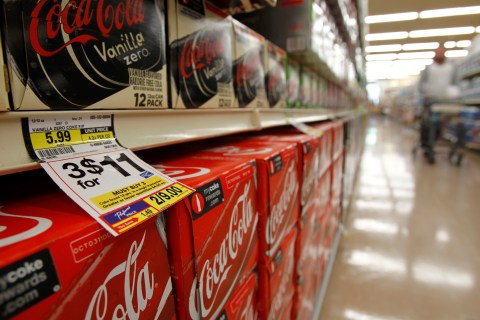
A shopper walks by the sodas aisle at a grocery store in Los Angeles
The American Beverage Association has spent millions to fight soda taxes proposed across the country. In Richmond — which, along with El Monte, has one of California’s higher rates of obesity in children — the ABA has funded billboards criticizing the bill and pledged to spend more to fight its passage, Reuters reported. The group is backing a lawsuit in El Monte that challenges the language of that city’s proposed soda tax.
But big beverage companies — many of them multinational firms with diverse product lines — may have less to fear from taxes or bans on soda than their efforts to fight them might indicate, according to Wharton finance professor Robert Inman. “If I’m Pepsi, and if you start taxing soda, I will produce non-sugary drinks like water,” Inman states. “How many [net] jobs were lost because of cigarettes? Phillip Morris (now Altria Group) … [went on to sell] cigarettes in Africa.”
(MORE: Apple Planning Pandora Rival)
Making a Difference — But at What Cost?
Too many sugary drinks are just one factor contributing to the nation’s obesity problem, but Brownell says that the beverages are an obvious target for people trying to mitigate the problem through legislation. “One, it’s the single-greatest source of added sugar in the American diet. Two, it offers no nutritional value…. Three, there is rock-solid proof linking consumption of these beverages to obesity and diabetes. Four, the body doesn’t recognize calories when they are delivered in liquids. We don’t feel full.”
He predicts that the impact of a soda ban or tax would be similar to what happened with laws aiming to decrease tobacco use. “Youth were particularly affected by tobacco taxes because they had less money than adults did. That’s a public health bonus, because if you discourage people from bad habits when they are young, you can prevent a lifetime of bad habits.”
For other experts, however, the potential benefits of such laws are less clear. The calories contained in a large soda alone “don’t explain the growth in obesity,” according to Jay Bhattacharya, a professor of medicine at Stanford University. Quoting statistics from the United States Department of Agriculture, Bhattacharya notes that “people eat about 500 more calories [a day] than they did 30 years ago. In 1975, we ate an average of 2,250 calories a day per person, and in 2000 we ate an average of 2,750 calories per person per day.” By raising the price of food, he adds, “we reduce what people consume. The problem is there are other high-calorie, empty-nutrition foods [besides soda]. Focusing on one item is unlikely to address the obesity problem.”
(MORE: 12 Things You Should Always Haggle Over)
Laws that spur people to drink less soda could also prompt them to replace one bad habit with another. “What if you buy tea and put sugar in it?” Pauly asks. “What if you make a milkshake with two non-taxed items? [Then] what do you tax? People will always try to find substitutes.”
The proposals on the table in New York, California and elsewhere merely try to curb the consumption of one type of food, but they don’t necessarily steer consumers toward a healthier choice, notes David Asch, a Wharton health care management professor and executive director of the Leonard Davis Institute of Health Economics. “[Everyone] can agree that the correct amount of cigarettes is [none.] But even though we have an obesity epidemic, the correct answer is not for everyone to stop eating,” he states. “For that reason, people have different views about full-calorie soda than they do about tobacco.”
Everybody’s Problem?
Many opponents fear that laws that try to govern what people eat and drink will lead to a “nanny state” in which consumers are not permitted to exercise their own free will. “The conservative argument is: If people want to develop damaging lifestyles, let them adopt them,” Inman says. “My reply is: [Because of] the cost of obesity, you are raising [health insurance premiums for everyone.] It’s plausible that you have a right to free choice, as long as it doesn’t affect other people. But it does.”
Echoing Inman, Glanz notes, “We have all kinds of laws that discourage people from doing various things [that are bad for them], yet people get up in arms about [taxes on] food. They don’t remember that we already have a lot of government interference in what we eat,” such as laws governing food and restaurant safety.
But Bhattacharya says that arguments in favor of a tax overlook any long-term consequences. “We don’t want to impose taxes on people who are food insecure,” he says. “It’s a regressive policy that tends to fall hardest on the poor…. It’s not necessarily wrong; we just have to think about its effects.”
(MORE: Future of Retail: How Companies Can Employ Big Data to Create a Better Shopping Experience)