


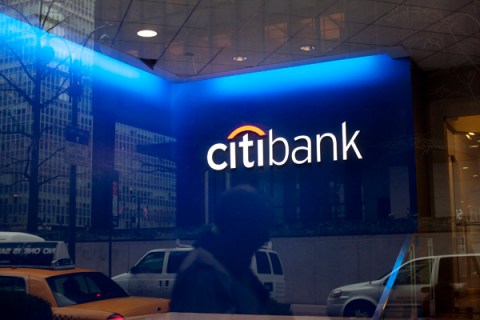
A man walks past Citigroup Inc. offices in New York, U.S., on Tuesday, Jan. 17, 2012.
With millions of people turning to costly payday loans and the hammer coming down on excessive bank fees, the time is right for financial firms to embrace what’s known as Safe Accounts. These are card-based electronic accounts used primarily at ATMs and the point of sale, and which carry extremely low fees.
Safe Accounts are a great option for the so-called unbanked — those who don’t have a traditional bank account — who spend $7.4 billion a year on payday loans. The average payday loan is for $375, and the average borrower ends up paying $520 in interest on that loan over five months, Pew Charitable Trusts found.
Meanwhile, Americans paid $38.5 billion in avoidable overdraft fees last year. A Safe Account, which is prohibited from assessing these fees, would serve as a valuable safeguard. In addition to the unbanked, this kind of account might be just the thing for teens getting their first experience with plastic and students on their own for the first time.
(MORE: Top Consumer Complaints: Our Latest, Biggest, Weirdest Grievances)
Banks need to do something because policymakers and customers have had it up to their eyeballs. Bank of America recently rolled back a $5 monthly fee for debit cards that many considered usury. The bank also settled excessive fee litigation for $410 million. Safe Accounts would be a great PR move for the banks, and the door has been pushed wide open.
Last year, nine banks ran a Safe Account pilot program designed by the Federal Deposit Insurance Corp., which reported that the accounts were not only popular with consumers but also profitable for the banks. Among the participating banks were Citi, ING, and Pinnacle. As a group, the banks found that Safe Accounts experienced no more overdraft issues or fraud than all accounts and that these new accounts helped grow the banks’ customer base.
The main features of a Safe Account are:
- Overdraft fees are prohibited
- Opening balance requirements are as low as $10
- Monthly balance requirements are as low as $1.
Safe Accounts were designed primarily with the unbanked in mind. The FDIC estimates that 7.7% of U.S. households—about 9 million households and 17 million adults—have no relationship with a bank. Reasons cited often include lack of resources but also fees they see as excessive and a simple lack of trust in financial institutions. In a survey, the FDIC found that most banks were aware that their market areas contained significant numbers of unbanked adults but few made an effort to serve them.
(MORE: How the Drought is Changing the Taste of Your Produce)
The Safe Accounts pilot program is beginning to change that. Several of the participating banks said they would extend the program. All of them were pleasantly surprised by the retention rate of these new customers: 80% stuck around, which is a higher rate than new accounts overall. Some banks had been concerned that these small accounts—the average balance was $244.20—would prove costly to police, fearing fraud attempts like empty envelope deposits. But such instances were isolated and occurred no more often than with other accounts. Perhaps most important, banks overwhelmingly reported that over-drawing on Safe Accounts was no more prevalent than on other accounts.
From a policy perspective, it’s critical that we bring more of the population into the banking mainstream, where they can cut down on fees and build credit. As reported by my Moneyland colleague Martha C. White, nearly 70% of payday loan users say they use this money for everyday expenses, and only 16% use the funds to cover an emergency or unexpected expense; 5% of people report taking out payday loans to buy food. The borrower usually pays about $15 to borrow $100 until their next paycheck.
Safe Accounts have another benefit too. They are opened in person with a bank official, who explains the nature of a savings account or card account and in so doing may significantly raise the financial I.Q. of the customer. “This type of financial education is integral to helping consumers build financial stability,” the FDIC concludes. A more money savvy population is in everyone’s interest.