


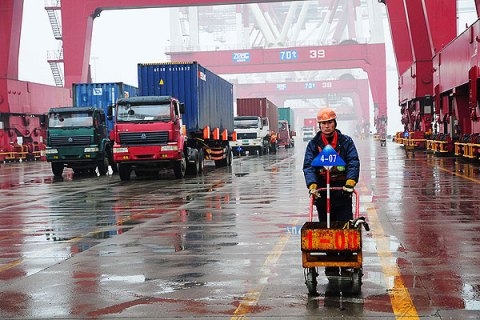
Trucks carry containers at Qingdao Port on March 5, 2012 in Qingdao, China. China has cut its economic growth target to 7.5 percent this year, from the 8 percent goal in 2011.
China’s Premier Wen Jiabao sent a shockwave through the global economy this week when he lowered the country’s GDP growth target for 2012, to 7.5% from 8%. In doing so, Wen was not only recognizing the tremendous headwinds China is facing from an uncertain global economy. He was also acknowledging that China needs to alter its growth model if the country’s economic miracle is to continue. Here are some comments from his Monday address, courtesy of state-news agency Xinhua:
Here I wish to stress that in setting a slightly lower GDP growth rate, we hope to make it fit with targets in the 12th Five-Year Plan, and to guide people in all sectors to focus their work on accelerating the transformation of the pattern of economic development and making economic development more sustainable and efficient, so as to achieve higher-level, higher-quality development over a longer period of time.
To ensure success in all our work this year, we must uphold the theme of scientific development, take transforming the pattern of economic development as the main thread, adopt a holistic approach and coordinate all our work. We must coordinate efforts to achieve steady growth, control prices, adjust the economic structure, improve people’s well-being, implement reform and promote harmony.
To be honest, I’ve had trouble figuring out why everyone got their underwear in a bunch over these comments. Sure, a slowing China would have negative implications for a global economy still suffering from the ill effects of the Great Recession and the ongoing sovereign debt crisis in Europe. Yet we should look at Wen’s statements with two key points in mind: First, the reality is China needs to slow its economy down. Second, China’s leadership shows no sign of allowing that to happen, no matter what nice speeches Wen might make. And that’s where the real threat to the world economy can be found.
(SPECIAL: China’s Century — or India’s?)
So we all know by now that what happens in China doesn’t stay in China – it impacts the entire world. China’s robust growth through the downturn practically rescued all of East Asia from the Great Recession, while giving a healthy boost to national economies from Australia to Brazil. As a major commodities importer, a slower China would likely mean lower prices for oil, iron ore, copper and other raw materials, dampening growth in many emerging markets. China’s economy has been a major source of new exports for the U.S., so a slowing China would directly hit American companies. Since China is the No.1 trading partner for most countries in Asia, a slower China would drag down growth across the region, and thus dampen overall global growth. In other words, if China’s GDP growth rate declines, just about everybody will feel it.
But let’s face it — a slower growth China is simply inevitable. The bigger China’s economy becomes, the harder it will be to notch those double-digit growth rates. It’s just a normal part of the development process. China is also confronting a radically different demographic profile that is likely to hold down potential growth. Due to the country’s controversial one-child policy, the population is aging rapidly, meaning it will have to carry the burden of a larger number of older, unproductive people relative to its active workforce. Economists generally believe that China’s growth rates over the next 20 years or so will not match those of the previous 20 years.
(VIDEO: Is China Readying to Kick the U.S. Out of the Western Pacific?)
And just about everybody also agrees that a slower Chinese economy would likely be a healthier one. Growth today is being propelled by an economic model that is creating distortions dangerous enough to lead to a crisis. Investment levels are way too high and the economy is too dependent on property development. Rising costs are testing the competitiveness of its export sector. A surge of debt is placing the health of the banking sector at risk. China needs to shift to a different growth strategy, one based less on investment and exports and more on domestic consumption – the much-promoted “rebalancing.” The economy must operate on a more commercial basis to make sure investment goes where it is truly needed. Wen Jiabao clearly acknowledged this in his speech. The leadership has said again and again that it is imperative that the country shift away from a growth-at-all-costs mentality and focus more on quality of growth and people’s living standards. That’s why the government set a growth target of 7% in its current five-year plan, announced a year ago.
In other words, everyone knows China has to slow down, and agrees it would be a good idea. But in the real world, there is no sign of China’s growth rate dropping anywhere near 7%. Nor is there any indication that the government will allow that to happen. Every time growth slips a bit, policymakers instantly jump in to stimulate it. GDP surged 8.9% in the fourth quarter of last year, well beyond the government’s stated targets, but that’s not fast enough for China’s leadership. The government is expected to run a larger budget deficit in 2012 than 2011 – a way to boost growth. And the central bank has already started to loosen credit by lowering the amount of cash banks have to set aside in reserve.
(PHOTOS: The Year of the Dragon)
So in the end, economists simply don’t believe Wen when he talks about slowing China down. Sun Junwei, an economist at HSBC, for example, wrote:
Envisaging another challenging year ahead, Beijing sets itself a 7.5% growth…target for 2012 as we expected. But given a bigger fiscal deficit and more steps towards monetary easing, we expect the GDP growth to hold up well at around 8.6% this year…We reiterate however that the lower GDP target should be seen more as the lower bound of Beijing’s range of acceptable growth forecasts, rather than as an actual growth forecast. Beijing has an impressive track record of overshooting its preannounced growth targets: for example, we refer to the average of 11% y-o-y actual growth vs. 8% y-o-y target growth for 2005-2011.
Translation from economics into English: Wen’s growth forecast is meaningless. That point was reinforced by Yu Song, an economist at Goldman Sachs:
In practice, the GDP growth target should be read as the lower bound of the comfort zone instead of a point target the government will try to achieve. A lower GDP target thus would imply a lower tolerable level. We think a slightly lower GDP growth target rate is sensible given the fall in the level of potential GDP growth…(The lower forecast is) a change of mere 0.5% which is within the margin of measurement errors of GDP data, hence not very important by definition.
Why does China insist on keeping its growth so high? The fact is that the government is much too worried about the potential social fallout (read: widespread unrest) to allow the economy to slow. And since the government’s legitimacy is based on providing rapid economic development (in exchange for repressed civil liberties), a slower economy threatens the leadership’s right to rule. In a way, that’s good news, at least in the short term, since we can expect policymakers to do whatever they can to keep the economy roaring.
(MORE: Solar Eclipsed: U.S. Solar Manufacturers Decry Unfair Chinese Competition)
For me, though, the world should be more worried about the potential fallout from a China that doesn’t slow down than a China that does. Sure, reduced Chinese growth will hurt the global economy. But an unreformed China that refuses to change its economic model and promotes growth at all costs is a much bigger danger to world economic stability. Wen Jiabao is exactly correct about what China must do. Now let’s see if it really gets done.