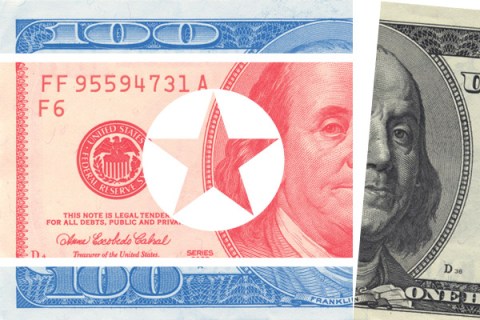
How the U.S. Could Pressure North Korea Tomorrow: Quit the $100 Bill

Photo-Illustration by TIME

U.S. negotiators are heading into a second day of what have been dubbed “serious and substantial” talks with North Korean officials. Yet amid all the discussion of how the U.S. will attempt to work with Kim Jong Un, there has been little (open) speculation as to whether Dear Leader Junior might crank up production of $100 and $50 bills. No, not North Korean 100- or 50-won banknotes, worth about as much as old tissues. I’m talking about fake greenbacks — or as the U.S. Secret Service has dubbed them, “superdollars.”

These ultra-counterfeits are light-years beyond the weak facsimiles produced by most forgers, who use desktop printers. As an anticounterfeiting investigator with Europol once put it, “Superdollars are just U.S. dollars not made by the U.S. government.” With few exceptions, only Federal Reserve banks equipped with the fanciest detection gear can identify these fakes.

Yet as unpatriotic as this may sound, perhaps America would be better off if Kim Jong Un were to try and enrich himself with DIY Benjamins. Let me explain, by way of a little background about superdollars.

(MORE: Can a Second Bailout Save Greece?)

The “super” moniker does not stem from any particular talent on the part of the North Koreans. It’s a matter of equipment. The regime apparently possesses the same kind of intaglio printing press (or presses) used by the U.S. Bureau of Engraving and Printing. A leading theory is that in 1989, just before the collapse of the Berlin Wall, the machines made their way to North Korea from a clandestine facility in East Germany, where they were used to make fake passports and other secret documents. The high-tech paper is just about the same as what’s used to make authentic dollars, and the North Koreans buy their ink from the same Swiss firm that supplies the U.S. government with ink for greenbacks.

Forging $100 bills obviously gels with the regime’s febrile anti-Americanism and its aim to undercut U.S. global power, in this case by sowing doubts about our currency. State-level counterfeiting is a kind of slow-motion violence committed against an enemy, and it has been tried many times before. During the Revolutionary War, the British printed fake continentals to undermine the fragile colonial currency. Napoleon counterfeited Russian notes during the Napoleonic Wars, and during World War II the Germans forced a handful of artists and printing experts in Block 19 of the Sachsenhausen concentration camp to produce fake U.S. dollars and British pounds sterling. (Their story is the basis of 2007 film The Counterfeiters, which won an Oscar for Best Foreign Language Film.)

Superdollars can be viewed as an act of economic warfare, but Pyongyang’s motive is probably more mundane: the regime is broke. The 2009 attempt to raise funds by devaluing its already pathetic currency revealed not only the country’s fiscal desperation but also the abuse the Dear Leader was willing to inflict on his people. The won was devalued 100-fold, which meant 1,000 won suddenly had the purchasing power of 10 won. (Imagine waking up to learn that a slice of pizza costs $250.) Officials set a tight limit on how much old money could be exchanged for new, so whatever value existed within people’s paltry savings evaporated overnight. Compared to devaluation, generating quick cash by counterfeiting another country’s more stable currency looks downright humanitarian.

(MORE: TIME Interview with Warren Buffett)

The superdollar affair has a certain comic-book quality: copying the currency of evil capitalists so you can buy cognac and missiles. But Washington isn’t laughing. At the end of December, Ireland’s high court rejected a U.S. request to extradite former Workers Party president and IRA veteran Sean Garland for his alleged involvement with the superdollar plot. There is also the question of what exactly the North Koreans hope to procure with all this “money.” According to the U.S. House Task Force on Terrorism and Unconventional Warfare, superdollars may be part of the regime’s effort to acquire materials for nuclear weapons.

Since the superdollars were first detected about a decade ago, the regime has been pocketing an estimated $15 million to $25 million a year from them. (Other estimates are much higher — up to several hundred million dollars’ worth.) That sounds like a lot of money, but compared to the $1 trillion in cash circulating in the great ocean of commerce, a few hundred million is chump change. Although costly for small-business owners who unknowingly accept a bunch of forgeries, counterfeits probably won’t bring about a crisis of faith in our paper money anytime soon.

Yet taking the long view, maybe a rash of new superdollars from the hermetic regime of Kim Jong Un would be beneficial. How so? Because counterfeits have a way of reminding people of what material money is and how it functions, and that could lead to a discussion of its pros and cons. Cash is, and always has been, such an uncontested part of everyday life that we rarely stop to consider its toll on society as the currency of crime, to say nothing of the heaping expense of printing, transporting, securing, inspecting, shredding, redesigning, reprinting, reinspecting and redistributing it ad nauseam, plus the broader costs of prosecuting and incarcerating the thousands, if not millions, of people who commit cash-related crimes. That’s not to suggest we could get rid of paper money tomorrow; we still don’t have a substitute that’s equally convenient, universally accepted and adequately secure. But that day may be closer than you think. (Coins, however, we could — and should — do away with. As in, right now.)

(MORE: Google Takes Another Experimental Step Toward Delivering TV)

Superdollars and the untold billions of (electronic) dollars spent combating them could be the wake-up call that finally forces us to think more clearly about the costs of physical money. If killing all cash strikes you as too radical, consider for a moment what it would mean to get rid of high-denomination banknotes. Who would be most inconvenienced if Washington were to outlaw $100 and $50 bills tomorrow? Cartel bosses in Juárez, Mexico, jump to mind. So do human traffickers in China and Africa, aspiring terrorists in Afghanistan, wildlife poachers, arms dealers, tax evaders and everyday crooks who hold up mom-and-pop groceries. And, of course, North Korean government officials.

So then. At the risk of infuriating cash-hoarding militia members, anonymity-obsessed ACLUers, the U.S. Treasury, Russian mobsters, Laundromat owners and just about every person who has ever hid a purchase from a spouse or income from the government, I would say this to Kim Jong Un and his posse of counterfeiters: Bring it.

Wolman is a contributing editor at Wired and the author of The End of Money: Counterfeiters, Preachers, Techies, Dreamers—and the Coming Cashless Society, out this month from Da Capo Press. Follow him on Twitter: @davidwolman.

[Correction: This piece originally said the "won was devalued by 100 percent, which meant 1,000 won suddenly had the purchasing power of 10 won." It has been corrected to read, "The won was devalued 100-fold."]

Related Topics: currency, forgery, monetary policy, North Korea, Economy & Policy
  • Latest on Business

    Book Review: What America's Banana King Teaches Us About Capitalism

    Book Review: What America’s Banana King Teaches Us About Capitalism

    Americans puzzling over the role of today’s powerful corporations — Bain Capital, Goldman Sachs, Google — may profit from considering the example of the United Fruit Company.

    It seems almost quaint to think that a company specializing in bananas might have once been considered a capitalist giant on the level of today’s firms, but so it was — at its height in the first half of the last century, United Fruit owned one of the largest private navies in the world. It owned 50 percent of the private land in Honduras and 70 percent of all private land and every mile of railroad in Guatemala.

    The Bomb Hidden in Mitt Romney's Education PlanSlate

    Ed Freeman / Getty Images

    Why Companies Can No Longer Afford to Ignore Their Social Responsibilities

    In 1970, the economist and Nobel laureate Milton Friedman published an article in The New York Times Magazine titled, “The Social Responsibility of Business Is to Increase Its Profits.” In the article, he referred to corporate social responsibility (CSR) programs as “hypocritical window-dressing,” and said that businesspeople inclined toward such programs “reveal a suicidal impulse.” Even four decades ago, at a time of growing public concern for the environment, his views represented the general skepticism and contempt with which many in Corporate America viewed CSR.

  • http://www.lewrockwell.com/blog/lewrw/archives/106325.html How Dare North Korea Try To Stimulate the World Economy « LewRockwell.com Blog

    [...] copying the Fed. (Thanks to Robert Hiett) Bookmark/Share | Suggest a Link « Previous: Syria Has [...]

  • http://www.raysemko.com/2012/02/24/dice-radio-24-feb-2012/ DICE Radio for 24 February 2012

    [...] How the U.S. Could Pressure North Korea Tomorrow: Quit the $100 Bill [...]

  • http://community54.com/?p=4945 Counterfeiting American Money Is Big Business In North Korea | Community 54

    [...] pm No Comments Great part about being a shady government is that you can literally print money. (TIME) U.S. negotiators are heading into a second day of what have been dubbed “serious and [...]

  • http://besslerreport.com/u-s-pressure-north-korea-tomorrow/ How the U.S. Could Pressure North Korea Tomorrow | The Bessler Report

    [...] U.S. negotiators are heading into a second day of what have been dubbed “serious and substantial” talks with North Korean officials..fake greenbacks the U.S. Secret Service has dubbed “super dollars.” These ultra-counterfeits are light years beyond the weak facsimiles produced by most forgers, who use desktop printers. As an anti-counterfeiting investigator with Europol once put it: “Superdollars are just U.S. dollars not made by the U.S. government.” With few exceptions, only Federal Reserve banks equipped with the fanciest detection gear can identify these fakes..read more @ Time [...]

  • http://defenceforumindia.com/indo-pacific-east-asia/32320-another-thing-thats-keeping-north-korea-afloat-50-100-superdollars.html#post432499 Another Thing that’s Keeping North Korea Afloat: $50 and $100 Superdollars

    [...] won." It has been corrected to read "The won was devalued 100-fold…"] Read more: How the U.S. Could Pressure North Korea Tomorrow: Quit the $100 Bill; North Korea is minting superdo… Reply Tweet « Again: North Korea Threatens [...]

  • http://www.freemarketers.com/north-korea-creating-counterfeit-superdollars/ North Korea creating counterfeit “Superdollars” : FreeMarketers

    [...] is a little known fact that the North Korean regime routinely prints up its own $50 and $100 bills and uses them as cash money to purchase supplies and military gear. These ultra-counterfeits are [...]

  • http://www.meneame.net/story/corea-norte-billetes-dolar-perfectos-eeuu-esta-tratando-dejen Corea del Norte y sus billetes de dólar perfectos: EEUU está tratando de apretarles para que dejen de hacerlos [ENG]

    [...] "CRITEO-300×250", 300, 250); 1 meneos Corea del Norte y sus billetes de dólar perfectos: EEUU está tratando de apretarles para que dejen… business.time.com/2012/02/24/how-the-u-s-could-pressure-n…  por timonoj hace [...]

  • http://cuentamelo.net/EspirituLibre/2012/02/25/corea-del-norte-y-sus-billetes-de-dolar-perfectos-eeuu-esta-tratando-de-apretarles-para-que-dejen-de-hacerlos-eng/ Corea del Norte y sus billetes de dólar perfectos: EEUU está tratando de apretarles para que dejen de hacerlos [ENG] | Cuéntamelo España

    [...] » noticia original Comparte [...]

  • http://thenorthkoreablog.com/2012/02/27/north-korean-counterfeiting/ North Korean Counterfeiting | The North Korea Blog

    [...] more about NoKo’s counterfeiting here. Share this:ShareEmailStumbleUpon   Share this piece of the [...]

  • http://www.laopiniononline.com/economia/como-dinero-del-monopoly.html Como dinero del Monopoly | La Opinion Online

    [...] Fuente: business.time.com [...]

  • http://globaleconomicwarfare.com/2012/02/counterfeiting-the-dollar-north-koreas-secret-weapon/ Counterfeiting the Dollar: North Korea’s Secret Weapon

    [...] annually, maybe the most significant export the North Koreans have (pages 24- 25). Last week, Time Magazine acknowledged this with an article by David Wolman. Describing the North Korean counterfeits, Wolman states: “These ultra-counterfeits are [...]

  • http://www.quora.com/If-the-cashless-society-means-an-end-to-transaction-anonymity-then-do-you-still-want-a-cashless-society If the 'cashless society' means an end to transaction anonymity, then do you still want a cashless society? – Quora

    [...] anonymity, because with most transactions, people do not want or need that level of privacy. See: business.time.com/2012/02/24/how…RepostCannot add comment if you are logged out.   Add [...]

  • http://americainversion.com/?p=1738 Los superdólares norcoreanos y los amantes del Pisuerga | Inversión en América

    [...] falsificados por el paraíso comunista de Extremo Oriente. Si uno rasca en la fuente, en la noticia del Time, tiene gracia, ya que parace ser que la maquinaria paran relicarios proviene de la extinta [...]

  • http://www.soundmoneyproject.org/?p=6977 Atlas Sound Money Project » Blog Archive » U.S. Feeling Pressure From North Korean Competition

    [...] Read more… [...]

  • http://russianlanguagelearning.com/best-russian-language-course.html Best Russian Language Course | RussianLanguageLearning.com

    [...] How The U.S. Could Pressure North Korea Tomorrow: Quit The $100 BillU.S. negotiators are heading into a second day of what have been dubbed “serious and substantial” talks with North Korean officials. Yet amid all the discussion of how the U.S. will attempt to work with Kim Jong Un, there has been little (open) speculation as to whether Dear Leader Junior might crank up production of [] … Read News [...]

  • http://www.politics.ie/forum/current-affairs/184375-sean-garland-us-request-extradition-rejected-north-korea-conterfeit-us-dollars.html#post5082080 Sean Garland: US request for extradition rejected: North Korea Conterfeit US dollars

    [...] [...]

  • http://www.ente-mx.com/los-superdolares-norcoreanos-y-los-amantes-del-pisuerga.html Los superdolares norcoreanos y los amantes del Pisuerga

    [...] falsificados por el paraíso comunista de Extremo Oriente. Si uno rasca en la fuente, en la noticia del Time, tiene gracia, ya que parace ser que la maquinaria paran relicarios proviene de la extinta [...]

  • http://www.pretenseofknowledge.com/2012/03/27/a-few-random-morning-links-206/ A Few Random Morning Links … | The Pretense of Knowledge

    [...] Are the North Koreans now masters of counterfeits $100 bills? [...]

  • http://stuffbqknows.wordpress.com/2012/05/14/counterfeiter-tries-to-pawn-fake-bills-instead-of-spending-them/ Counterfeiter Tries to Pawn Fake Bills Instead of Spending Them | Stuff BQ Knows

    [...] that only the most sophisticated machinery can tell from the real stuff. TIME has an article on it here worth reading if that kind of stuff interests you.  Super Evil regimes aside, we’ll get back [...]

  • http://business.time.com/2012/05/22/how-cash-keeps-poor-people-poor/ How Cash Keeps Poor People Poor | Business | TIME.com

    [...] (MORE: How the U.S. Could Pressure North Korea Tomorrow: Quit the $100 Bill) [...]

blog comments powered by Disqus