Can a Second Bailout Save Greece?

Yves Herman / Reuters
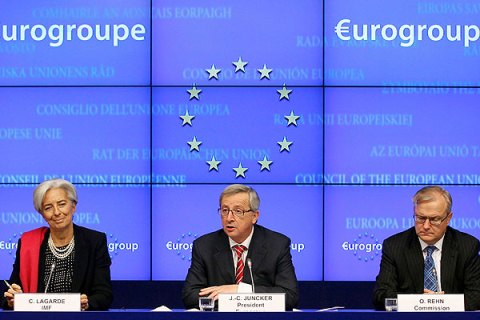
IMF Managing Director Christine Lagarde, Eurogroup Chairman and Luxembourg's Prime Minister Jean-Claude Juncker and European Monetary Affairs Commissioner Olli Rehn (L-R) hold a joint news conference after a Eurogroup meeting in Brussels February 21, 2012.

After months of delays, arguments and doubts, euro-zone finance ministers agreed on a second, $170 billion bailout of beleaguered Greece in the early hours of Tuesday morning. The agreement will not only provide fresh financing for the debt-stricken government but also some much needed debt relief. A hefty chunk of the new bailout package will be used to support a restructuring of $265 billion of Greek sovereign debt, in which private creditors will take a larger-than-expected loss in a swap of their current bond holdings for longer-term replacements. This bailout also includes funds to recapitalize the shattered Greek banking system. Though some hurdles remain — all 17 euro-zone countries still must approve the bailout’s terms — the deal will put an end to fears of an unruly Greek default.

The big question remaining, though, is, for how long? The first bailout, inked in May 2010, was considered by many to be dead on arrival, an unrealistic attempt to solve Greece’s debt crisis without tackling the serious, underlying problems. Doubts about that deal did nothing to stop contagion from spreading to other weak euro-zone economies, threatening the entire monetary union. Now here we are, nearly two years later, and this second deal is plagued by many of the same failings and faulty assumptions of the first. That means this latest bailout may not be a real solution to the Greek debt crisis, but merely another stopgap that prevents an immediate crisis while postponing more tough decisions to a later date.

(MORE: What Happens if Greece Doesn’t Get a Bailout?)

The first major flaw in the bailout is that it doesn’t go far enough to ensure Greece can manage its mountain of debt. The proposed restructuring is expected to bring down the country’s debt level to only 120% of GDP by 2020. That’s a nice drop from the 160% today. But it is still remarkably high — the level of Italy’s debt burden today. And that’s a best-case scenario. In an assessment leaked to the press on Monday, the IMF figured that in 2020, Greece might end up with the same level of debt is has today. So what all this means is that doubts will remain firmly in place about Greece’s ability to pay back its debts in the future.

The reason Greece’s debt load is so difficult to shrink is because the economy is tanking. The austerity measures and other reforms demanded by the euro zone in return for its rescue money are causing the Greek economy to contract sharply — by an estimated 7% in 2011. Further budget cuts imposed for this second bailout — another $4.4 billion of austerity measures were approved by Greece’s Parliament last week — will only inflict more pain and cause the economy to continue to contract. The new reforms include a reduction in the minimum wage and major public-sector job losses, which will slice into local demand and undercut the prospects for growth. So Greece ends up like a dog chasing its tail. Meeting deficit targets and reducing debt becomes much more difficult when the economy is shrinking. The austerity at the heart of the euro-zone bailout program, therefore, is killing off the chances the bailout program can resolve the debt crisis.

(MORE: The Most Important Man in Europe)

And the second bailout also assumes that Greek politicians will remain committed to their reform pledges. They so far they have failed to follow through on reform, and there is no reason to believe that will change. Antonis Samaras, the leader of the New Democracy party who is most likely to become Prime Minister after April elections, has already raised the prospect of renegotiating the bailout terms. The euro zone’s finance ministers have so little faith in the Greek government’s ability to reform that they have adopted special measures to force its hand. The euro zone will keep a permanent mission in Athens to monitor the reform effort, and the government will be required to deposit debt payments in advance into a special account before it can use funds for its own budget. In other words, Greece is being treated like an incompetent child by the rest of Europe.

Is any of this sustainable? Probably not. Greece’s debt will remain much too high. The government’s attempts to reform will continue to meet fierce public resistance. The Greek economy, and the livelihoods of the Greek people, will continue to deteriorate. Add in the impact of the debt restructuring — which is imposing significant losses onto private investors — and Greece may not be able to resume financing itself for quite a long time. That raises the prospect that a third bailout plan may become necessary — even though the first two have already run up a bill that tops 100% of Greece’s GDP.

My sense is that what the leaders of the euro zone are again hailing as a landmark agreement will, like all the other landmark agreements of the past two years, seem completely insufficient six months from now. Simply put, the Greek debt crisis isn’t over, and neither is the threat to the survival of the euro.

PHOTOS: Protests in Athens

Related Topics: bailout, Debt Crisis, europe, Greece, Economy, Economy & Policy, Europe
  • Latest on Business

    Book Review: What America's Banana King Teaches Us About Capitalism

    Book Review: What America’s Banana King Teaches Us About Capitalism

    Americans puzzling over the role of today’s powerful corporations — Bain Capital, Goldman Sachs, Google — may profit from considering the example of the United Fruit Company.

    It seems almost quaint to think that a company specializing in bananas might have once been considered a capitalist giant on the level of today’s firms, but so it was — at its height in the first half of the last century, United Fruit owned one of the largest private navies in the world. It owned 50 percent of the private land in Honduras and 70 percent of all private land and every mile of railroad in Guatemala.

    The Bomb Hidden in Mitt Romney's Education PlanSlate

    Ed Freeman / Getty Images

    Why Companies Can No Longer Afford to Ignore Their Social Responsibilities

    In 1970, the economist and Nobel laureate Milton Friedman published an article in The New York Times Magazine titled, “The Social Responsibility of Business Is to Increase Its Profits.” In the article, he referred to corporate social responsibility (CSR) programs as “hypocritical window-dressing,” and said that businesspeople inclined toward such programs “reveal a suicidal impulse.” Even four decades ago, at a time of growing public concern for the environment, his views represented the general skepticism and contempt with which many in Corporate America viewed CSR.

  • http://thepage.time.com/2012/02/21/second-bailout-reached/ The Page by Mark Halperin | Second Bailout Reached

    [...] TIME's Schuman: Can a Second Bailout Save Greece? Tweet Related Topics: greek bailout, greek debt, News, The Page [...]

  • http://www.newsaddicts.com/popular-news-today/highlights-comments-from-meeting-of-eu-finance-ministers-reuters.html HIGHLIGHTS-Comments from meeting of EU finance ministers – Reuters — News Addicts

    [...] seven-month highsReuters UKGreece secures bailout to avoid debt defaultSeattle Post IntelligencerTIME -Reuters UK -CTV.ca -NDTVall 4,266 news [...]

  • http://globalpublicsquare.blogs.cnn.com/2012/02/21/roundup-eurozone-approves-new-greek-bailout/ Roundup: Eurozone approves new Greek bailout – Global Public Square – CNN.com Blogs

    [...] of the first. That means this latest bailout may not be a real solution to the Greek debt crisis, but merely another stopgap that prevents an immediate crisis while postponing more tough decisions to a later date," writes TIME's Michael [...]

  • http://www.decideamerica.com/can-a-second-bailout-save-greece Can a Second Bailout Save Greece? | Decide America

    [...] Read the complete article at Time   If you enjoyed this article, please consider sharing it! [...]

  • http://business.time.com/2012/02/22/will-high-gas-prices-hurt-obama/ Iran sanctions are pushing up oil prices; will resultant higher gas prices sink Obama in the November election? | Business | TIME.com

    [...] (MORE: Can a Second Bailout Save Greece?) [...]

  • http://www.nilenewsnt.com/?p=88678 Will High Gas Prices Hurt Obama? – شبكة النيل الإخبارية

    [...] (MORE: Can a Second Bailout Save Greece?) [...]

  • http://business.time.com/2012/02/24/how-the-u-s-could-pressure-north-korea-tomorrow-quit-the-100-bill/ How the U.S. Could Pressure North Korea Tomorrow: Quit the $100 Bill; North Korea is minting superdollars | Business | TIME.com

    [...] (MORE: Can a Second Bailout Save Greece?) [...]

  • http://bluhost.us/archives/4627 How the U.S. Could Pressure North Korea Tomorrow: Quit the $100 Bill | bluhost.us

    [...] Yet as unpatriotic as this may sound, perhaps America would be better off if Kim Jong-un were to try and enrich himself with D-I-Y Benjamins. Let me explain, by way of a little background about superdollars.(MORE: Can a Second Bailout Save Greece?) [...]

  • http://www.thenewsworld.info/counterfeit-100-bills-keeping-north-korea-afloat.html Counterfeit $100 bills keeping North Korea afloat | The News World™ || Your One Stop Social Network News Station™

    [...] Yet as unpatriotic as this may sound, perhaps America would be better off if Kim Jong-un were to try and enrich himself with D-I-Y Benjamins. Let me explain, by way of a little background about superdollars.(MORE: Can a Second Bailout Save Greece?) [...]

  • http://www.articledin.com/en/2012/02/north-korea-stays-afloat-with-fake-u-s-100s/ North Korea stays afloat with fake U.S. $100s | Articled In

    [...] Yet as unpatriotic as this might sound, maybe America would be improved off if Kim Jong-un were to try and heighten himself with D-I-Y Benjamins. Let me explain, by approach of a tiny credentials about superdollars.(MORE: Can a Second Bailout Save Greece?) [...]

  • http://ramkshrestha.wordpress.com/2012/02/25/how-the-u-s-could-pressure-north-korea-tomorrow-quit-the-100-bill/ How the U.S. Could Pressure North Korea Tomorrow: Quit the $100 Bill « Nepal – the country of the Mt. Everest and the Buddha

    [...] (MORE: Can a Second Bailout Save Greece?) [...]

  • http://investmentwatchblog.com/how-the-u-s-could-pressure-north-korea-tomorrow-quit-the-100-bill/ How the U.S. Could Pressure North Korea Tomorrow: Quit the $100 Bill « Investment Watch Blog – 2012

    [...] Yet as unpatriotic as this may sound, perhaps America would be better off if Kim Jong-un were to try and enrich himself with D-I-Y Benjamins. Let me explain, by way of a little background about superdollars.(MORE: Can a Second Bailout Save Greece?) [...]

  • http://www.globalvirtualstudio.com/alpha.php/2012/02/how-the-u-s-could-pressure-north-korea-tomorrow-quit-the-100-bill-north-korea-is-minting-superdollars-business/ How the U.S. Could Pressure North Korea Tomorrow: Quit the $100 Bill; North Korea is minting superdollars | Business « GVS | Global Virtual Studio

    [...] (MORE: Can a Second Bailout Save Greece?) [...]

  • http://business.time.com/2012/03/05/is-germanys-euro-crisis-strategy-actually-working/ Angela Merkel: Is Germany’s Euro Crisis Strategy Actually Working? | Business | TIME.com

    [...] after much drama, looks likely to get both a restructuring of its debt and a second, $170 billion bailout. An emergency cash-injection program by the European Central Bank has eased conditions in the [...]

  • http://www.nilenewsnt.com/?p=99484 Is Germany’s Euro Crisis Strategy Actually Working? – شبكة النيل الإخبارية

    [...] many drama, looks approaching to get both a restructuring of a debt and a second, $170 billion bailout. An puncture cash-injection module by a European Central Bank has eased conditions in a banking [...]

blog comments powered by Disqus