


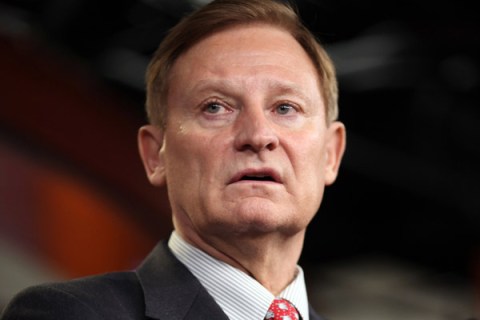
Rep. Spencer Bachus, an Alabama Republican, is facing a Congressional investigation over insider trading allegations.
A powerful member of Congress is under investigation for possible insider-trading violations, following a series of reports detailing how lawmakers benefit from high-level information they receive during the course of their jobs. Rep. Spencer Bachus, an Alabama Republican, faces an inquiry by the Office of Congressional Ethics over his trading activity, including bets he made against the financial markets at the height of the 2008 banking crisis, when he was receiving closed-door briefings from top officials describing the severity of the situation.
Bachus, who is now chairman of the House Financial Services Committee, denies any improper activity, but the inquiry, first reported by The Washington Post on Friday, is another black-eye for Congress at a time when public approval of lawmakers is at an all-time low. According to the paper, congressional investigators “have found probable cause to believe insider-trading violations have occurred.” That means that the matter now must be referred to the House Ethics committee, which has 45 days to decide whether to pursue a formal investigation.
Investigators are probing whether Bachus violated Securities and Exchange Commission laws by making trades on “material, non-public” information, as well as congressional rules that bar lawmakers from using their official positions for private gain, the paper reported.
(More: Spencer Bachus: Congressman, Stock Market Addict)
The investigation comes as Congress is working on legislation that would prohibit lawmakers from making financial trades based on information they learn in the course of their official duties. Last Thursday, the House passed the STOCK (Stop Trading on Congressional Knowledge) Act. The Senate has already passed a version of the bill, and now the two bodies have to reconcile their bills before President Obama can sign it, which he has pledged to do. Congress was moved to act amid public outrage following a “60 Minutes” report last fall that discussed Bachus’ trades. That report was based in part on a book called “Throw Them All Out,” by Stanford scholar Peter Schweizer, which detailed how lawmakers use privileged information for financial gain.
One series of trades by Bachus is the subject of particular scrutiny. On September 18, 2008, as the financial crisis was rapidly escalating and Wall Street bank Lehman Bros. teetered on the brink of collapse, Bachus received a closed-door briefing from then-Treasury Secretary Hank Paulson and Federal Reserve Chairman Ben S. Bernanke, who described the perilous state of the U.S. economy. The next day, Bachus, who was the highest-ranking Republican on the House Financial Services committee, placed heavily leveraged “short” trades betting that U.S. financial markets would fall. Bachus ceased his stock-trading activity in 2010 following a Wall Street Journal report that found he made about $28,000 betting against financial markets.
Bachus has vigorously denied any wrongdoing. “The Office of Congressional Ethics has requested information and I welcome this opportunity to present the facts and set the record straight,” the lawmaker said in a statement.