

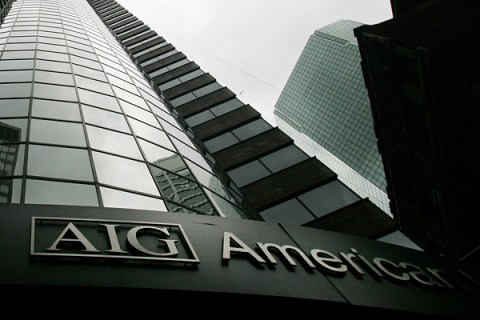
File photo of the AIG office building in New York.
If you thought the bank bailout that started in late 2008 was long gone, you would be far from wrong. The special investigator for TARP, the government fund that was created in the wake of the financial crisis, released a report last week that said the government is still owed $133 billion from the fund. In fact, there are 458 companies, most of which are small banks, that have yet to fully pay back the government. And it could be another 5 years before the bailout fund is fully wound down. Worse, we’re probably never going to get all of our money back. Best estimate for the final cost: $34 billion.
Still, TARP is not going to cost anywhere near as much as the headline grabbing $700 billion figure that was first associated with it. The reason is that while there was a public perception that money was given straight to bankers, only about one third of the money ever went to bailout financial institutions. The bulk of that money went to the nation’s largest institutions – Bank of America, Citibank, J.P. Morgan Chase, Wells Fargo and others. Those banks have all paid back the money the government gave them plus interest. And that briefly gave the impression that the government was going to make money on the bailout, but that no longer appears to be the case.
(MORE: Is the Fed Undermining the Recovery?)
Among the bailout deadbeats are AIG, General Motors and Chrylser. All three have paid back some of the money owed to the government. But the giant insurance company, the auto companies and their financing arms still owe the government nearly $90 billion collectively. Nearly $20 billion is still owed by community banks and thrifts. The report says there is no real plan on behalf of Treasury to help these still struggling banks repay the government.
The question, of course, is whether the bailout was worth it. The report doesn’t go into that. But if you really believe (as many have said) that the bailout averted a depression, then $34 billion, or about one fifth of one percent of the national GDP, seems like a pretty good deal. A depression could have erased 10% of our nation’s $15 trillion economy.
Still, there appears to be some massive failures in TARP. One of the reasons TARP didn’t cost more is because some of the programs never got off the ground. Perhaps the biggest tragedy of TARP was that the government could never figure out how to use the money to assist more struggling homeowners. Less than 10% of government’s $45 billion TARP-funded mortgage modification program ever got spent. Originally, it was estimated the program would help as many as 4 million homeowners facing foreclosure. So far, just over 750,000 homeowners have received modifications, and given how little money was spent, you can assume many of the most dire cases were rejected.
(MORE: Should Americans Care About Apple’s iPhone Factory Conditions?)
What’s more, in the end, the bank bailout appears to have done little to reign in excessive executive compensation. Early on, it looked like the government was going to pressure the big banks to dramatically rewrite their compensation schemes. There was hope that lower Wall Street pay might reset runaway CEO pay in general.
But, despite a par czar, that didn’t happen. According to the TARP inspector’s report, the government repeatedly pressured the pay czar Kenneth Feinberg to allow firms to pay more than the stated salary cap of $500,000. In all, 49 executives of bailed out firms received pay packages of $5 million or more between 2009 and 2011. A recent report from the Wall Street Journal found that even bankrupt companies appear to be continuing to hand out multi-million-dollar paydays to their CEOs.