



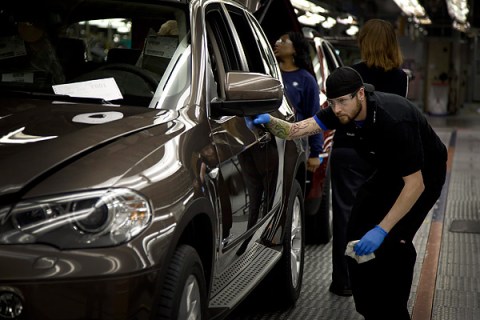
A worker inspects the body of a vehicle on the production line at the Bayerische Motoren Werke AG (BMW) manufacturing plant in Spartanburg, South Carolina, U.S., on Wednesday, Jan. 11, 2012. Bayerische Motoren Werke AG (BMW), the world's largest maker of luxury autos, will invest about $900 million in its South Carolina factory to expand capacity and prepare the facility to produce a new sport-utility vehicle.
Is America in the middle of a manufacturing job revival? The latest numbers would make it seem so. The U.S. has added more net manufacturing jobs since the start of 2010 than the rest of the G7 nations put together, with only two other economies, Germany and Canada, increasing factory employment at all.
The jump is due to a number of factors, including American productivity growth (which has outpaced Europe as a whole), compressed wages, and higher energy costs (which make it more costly to ship products back from locations with cheaper labor, like Asia). As the FT recently reported, from 2002-10, U.S. manufacturing unit labor costs in dollar terms fell 11 percent, compared with rises of 3 percent rise in Japan and 41 percent in Germany. Companies that are now bringing jobs back home include some of America’s largest blue chip multinationals, like Ford, GE, and United Technologies.
Does this mean the end of the shrinking middle? After all, decently paid manufacturing positions were the core of the middle income jobs bracket since the 1950s; the hollowing out of the manufacturing sector is a key reason that workers in rich countries haven’t gotten a real raise since the 1970s. Democrats would like us to think so. With jobs and the economy still the major campaign issue, the Obama administration has been making hay with the numbers in various speeches and press releases. The rhetoric will likely increase if Mitt Romney gets the Republican nomination, and Obama tries to position himself as the defender of the 99% in comparison to the former Bain “quarter billionaire.”
(MORE: Economists: A Profession at Sea)
As much as I’d like to believe that the insourcing trend has legs, and that manufacturing is coming back to American en mass, I think there are two important caveats to remember. First, as the McKinsey Global Institute’s James Manyika wrote in a recent report, “History shows that recessions—particularly those that follow a financial crisis—accelerate the growth or decline already underway in industries. In this [last] recession, for example, the auto, financial-services, and residential-real-estate industries have contracted significantly and won’t regain their peak employment anytime soon.” Yes, some jobs are being insourced, but so far it’s a trickle. The numbers look very good in comparison to other rich countries because investors and factory owners alike are afraid to put money into Europe right now. One CEO of a major European multinational industrial firm that I spoke with recently says he’s thinking of moving factories out of the Continent, because he’s worried about continuing social unrest due to the debt crisis, and permanently dampened consumer demand.
The bigger issue is that the displacement of human workers by technology (arguably the largest factor in the shrinking middle) is far from over – in fact, it may have only just begun. A number of big thinkers I’ve talked with recently, including not only the folks at McKinsey Global, but scientists at MIT, Stanford, and macro-economists like Ken Rogoff, have spoken of a growing digital economy that will have profound changes on labor markets. Machines have already replaced humans in many factory jobs, and an increasingly number of white collar gigs, too (computers can now do journalism, write music, and come up with trading algorithms). The real seismic shift will be when they start talking to each other; refrigerators bypassing purchasing officers to order more milk directly from factories, air traffic controllers made obsolete by interconnected web based systems, etc., etc. It’s been the stuff of heady articles in tech magazines for years, but it’s starting to happen. Brian Arthur, an economist at the Sante Fe Institute, estimates that the activity generated by the digital economy (that is, the economy created by machines alone) could equal that of the $62 trillion real world economy within two decades. The shift would shake manufacturing and service jobs alike.
(MORE: Home sales up at end of dismal year, offering hope)
So where does that leave manufacturing, and more importantly, all of us? Optimists like Rogoff would argue that all this innovation will inevitably create new positions that we can’t even dream up right now. There will be a period of great disruption, but then, some time later, we’ll all be happier and more prosperous for it. But pessimists (which may be greater in number) are worried that we need to start circling the wagons, focusing on more self-interested trade policies to keep decently paid jobs at home. I’m hearing the word “industrial policy” a lot these days, and not just in hyper-liberal circles. The Council on Foreign Relations recently put out a report calling for a rethinking of global trade rules and enforcement as countries like the U.S. struggle to hold their own against emerging market giants like China. Bottom line: (1) the corporate giants that have brought jobs back to the U.S. can send them abroad again just as quickly; and (2) we’re at the beginning of some very interesting policy discussions about how the global economy should be structured and policed in the 21st century.