


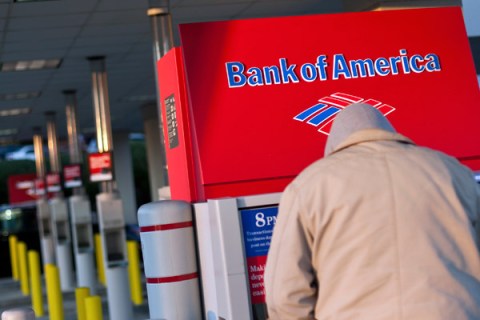
A Bank of America customer uses an ATM machine at a branch in Greenville, South Carolina Wednesday.
You can’t have a strong economy without strong banks. That’s why President Bush’s and, later, President Obama’s first attempts to save the economy from a deep recession were focused around bank bailouts. And the fact that the banks have remained weak, despite the government’s efforts, is one of the major reasons the economic recovery has been so slow.
So investors reacted with glee on Thursday when it appeared that at least some of the problems of the major banks could be behind them. Bank of America reported that it earned $1.4 billion in 2011, up from a loss of $2.2 billion in 2010. Earlier in the week, Citigroup had reported that its bottom line had grown to $11.6 billion last year, up 6% from a year ago. Even more striking: Bank of America and Citigroup’s rising earnings came at the same time Goldman Sachs and indeed investment banking in general appear to be struggling.
(MORE: Goldman Sachs Only Made $1 Billion Profit Last Quarter)
So is back-to-basics banking working again? Not quite. At least not for everyone. For Bank of America, much of its earnings boost came from selling assets, not its regular operations. In the first quarter alone, the company booked a $2.9 billion gain from the sale of a minority stake of China Construction Bank. Cost cutting seemed to help the bank as well. As did the fact that it put less money away for loan loss provisions, which cut costs but, with so many mortgage suits still outstanding, could also hurt Bank of America in the end.
But when it came to its core business of taking deposits and making loans, Bank of American didn’t seem any better at that than it has since the financial crisis. Revenue for its plain-vanilla deposit banking business fell by $900 million in 2011. The company did make more in that division than it did a year ago. But that’s not because it made better loans or brought in more deposits. Instead, the company fired people and closed branches, causing expenses to fall. That’s what produced the profit, and cost cutting can only boost the bottom line for so long.
(MORE: 5 Things to Look For in a Great Job Interview)
Citigroup, on the other hand, did appear to have a significant rebound in its most basic banking business. Profits from its consumer lending division rose nearly 30% to $6.2 billion. But that was because the company’s borrowing costs plummeted, and credit losses fell. Again, both things that are not necessarily repeatable.
The problem is that the Federal Reserve has set short-term interest rates low. And recently, the Fed has been trying to drive down longer rates as well, which should boost demand for lending and help heal the housing market by lowering mortgage rates — but the downside of the Fed fix is that it will continue to weaken the banks. Bankers make money off the spread between short-term interest rates (what they have to pay on deposits) and long-term interest rates (what they charge for loans). And it’s very hard to make money as a banker when the spread between those interest rates are as low as they are today. And it’s a situation that may not change anytime soon. The Fed has said that it plans to keep interest rates low at least through mid-2013. America’s banks are not going to be healed anytime soon.