View from Davos 2011: How Bad is a $1.5 Trillion Deficit?

Vincent Kessler / REUTERS
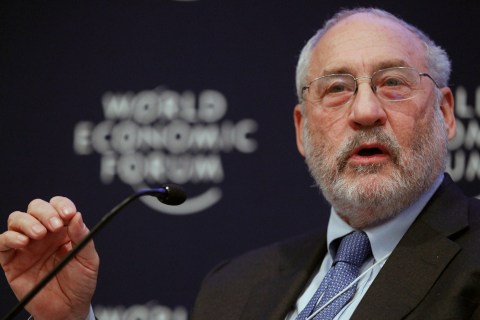
Joseph Stigliz is one of the many economists talking about debt at Davos

Now that we have the recovery, we will have to pay for it. The question is did we take the appropriate measures or did we overspend.

On Thursday, the CBO estimated that the federal deficit in 2011 will reach nearly $1.5 trillion. That’s up from nearly $1.3 trillion last year. Three years after the financial crisis many had hoped what were supposed to be temporary budget deficits would be shrinking by now. That’s especially true because early bailout measures like TARP ended up mostly paying for itself.

So why is the deficit still rising? It’s because the recession has turned out to be weaker than many expected, and unemployment has stayed high. The tax cut passed late last year, which some called a second stimulus, will alone add $400 billion to the debt this year. Here in Davos, where business and political leaders are meeting for the World Economic Forum, there are two views on debt that are being expressed. And at least one of them seems to suggest the recent run up in US deficits aren’t that bad. Here’s why:

The first view on debt is the obvious one. Perhaps, in part, because the World Economic Forum is located, conversations here and panel discussions are dominated by the European fiscal crisis. And the situation in Europe seems bad. Greece, Ireland and others have borrowed so much that many are worried they won’t be able to pay back their debts. The UK’s austerity measures may be causing that country to slip back into recession. Some are saying the Euro will have to be abandoned.

On that backdrop, the US debt seems bad. At a dinner of economists on Wednesday night, economist Carmen Reinhart predicted that the US was headed toward a crisis where we would be forced to cut many of our social services. Raghuram Rajan, a former chief economist at the IMF, said that the measures that the UK were making to deal with their deficit right now were a good move. He said we too should deal with our fiscal problems now, rather than putting them off.

But not everyone thinks the US debt problem is so dire. While the total deficit is larger this year than last year, it is slightly smaller as a percentage of GDP than last year. What’s more, the US many have more ability to borrow than other countries because of the dominant role of the dollar in the world economy. The fact that our dollars are so widely seen as a safe asset gives America the ability to borrow more than say Greece or Ireland before hitting the breaking point. Nobel prize winning economist Joseph Stiglitz, who is also at Davos, said that while he is worried about some of the US states debt problem, he thinks debt may not be as bad as some people think. In fact, Stiglitz would even be for increasing our debt even more. As long as it was spent on things like infrastructure and education, which can produce jobs, and boost incomes. So there is a debt cliff, but the US may not be there yet.

Related Topics: Davos, Davos, Economy & Policy
  • Latest on Business

    Brendan McDermid / Reuters

    Facebook’s Stock Falls Below $30 for First Time

    (NEW YORK) — Facebook’s stock has fallen below $30 for the first time since its much-awaited public debut this month.

    The Jury Is Out on the EuroSlate

    U.S. consumer prices rose faster than expected in May. (Mario Anzuoni / Reuters)

    Consumer Confidence in the Economy Plunged in May

    NEW YORK — American confidence in the economy suffered the biggest drop in eight months as worries about the weak jobs, housing and stock markets rattled them again. The decline comes after a few months of optimism amid some positive economic news.

  • waynebernard

    Numbers as large as $1,500,000,000,000 are something that mere mortals are not able to relate to, especially when they are preceded by a dollar sign. Here’s an article that may help:

    http://viableopposition.blogspot.com/2011/01/congressional-budget-offices-15.html

  • worleyeoe

    Then, multiply that number, a mere 365 days of Uncle Sam spending, by 10, and an order of magnitude smacks you in the face, sending your brain into a tizzy. Anyone suggesting that trillions of dollars in debt is not something to be concerned about should be lobotomized. Forgo the psychiatric examination and simply remove the brain, because they are not using it.

  • ps56penn62pr64

    Anyone who thinks cutting government spending is the answer to our economic problems does not know or understand our debt-based monetary and banking system. The western world is in this economic crisis because sovereign governments fail to issue their nation’s money.

    The failure is not new. This year is the two hundred years anniversary of a great constitutional battle with the banks in America, a battle started and lead by Thomas Jefferson and championed by, then President, James Madison. Facing rumors that British bankers would precipitate a war if the charter was not renewed, in 1811 congress refused to renew the charter of the first central bank of America on the grounds that the constitution gave the power and authority to issue the nation’s money to congress, not to a privately owned banking corporation.

    On the topic of money creation, Jefferson wrote, “If the American people ever allow private banks to control the issue of their currency, first by inflation, then by deflation, the banks…will deprive the people of all property until their children wake-up homeless on the continent their fathers conquered… The issuing power should be taken from the banks and restored to the people, to whom it properly belongs.”

    But we have not listened to Jefferson. The Federal Reserve and the banks that make up the monetary system are an assemblage of privately owned corporations that create 99.9% of our money as the principal of loans. Every dollar, with the exception of coins, is borrowed money, and it all must be repaid with interest. Since no one creates the interest, there is always an inherent shortage of money in our system. Furthermore, paying off the national debt in the present system would be disastrous, for if there were no national debt; there would be no money in our economy.

    Only sovereign governments can solve the western world’s economic problems. If soveereign government issued their money as a public utility, we would not have national debts, we would not pay a huge amount of tax revenue to the banks as interest, we would not have a scarcity of money in national economies, we would need to slash needed government services, nor would we need income taxes.

  • http://jimticket.wordpress.com jimticket

    Perhaps someone needs to remind the writer of this article that the tax cuts were in place before we had Trillion Dollar deficits. This idea that we are foregoing tax revenue due to the cuts assumes that they would take in every dollar projected. When has that ever happened?

    After the tax cuts were originally implemented, we had the highest tax revenue ever. The reason is because the economy was expanding quickly. One can argue the vailidaty of whether the tax cuts caused the economy to grow but the overall lesson: it’s the economy stupid! If you want to grow tax revenue, you don’t raise taxes, you grow the economy.

    The problem back then as it is now is that we didn’t curtail spending. Remember how the Congress originally reacted to the idea of an $800 billion bailout (TARP)? They voted against it. Then, they passed it after the stock market dropped 800 points. Now, the Congress isn’t afraid of those large numbers any more. These types of deficits are forecast through 2020. They don’t get it. They are going to run this country into a financial wall because only a crisis is going to bring our government together to take action.

    It’s sad but true.

blog comments powered by Disqus