Just How Weak is the Case Against Goldman Sachs?

Goldman Mouthpiece?

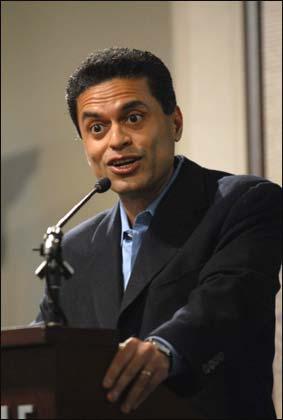
A growing number of people are chiming in to say that the SEC case against Goldman Sachs is not as strong as it seems. Not sure why they would say that. I have read the SEC complaint a few times and it seems like damaging stuff to me. Even if Goldman didn’t break the disclosure rules that are at the heart of the case against it, the whole thing just seems sleazy and morally wrong, and a great window into what went wrong on Wall Street in the past decade. If you are not Goldman or Paulson, I just don’t get why you would defend this behavior. Nonetheless, Newsweek’s foreign affairs expert Fareed Zakaria comes out swinging on the side of Goldman in a piece on CNN.com with some of the dumbest logic so far on why the SEC doesn’t really have a case. Zakaria is a pretty smart guy when it comes to the Middle East, but on business he seems way over his head. Here’s where Zakaria goes wrong:

Zakaria’s first point is one that my 3-year-old would make. It’s the “everyone else was doing it” excuse.

“I’m largely in favor of financial reform,” Zakaria told CNN. “But I also believe in the rule of law, and I believe people should be innocent until proven guilty. And the government should not use the police power of the state to retroactively criminalize things that were considered fine when the market was going up.”

Bubbles always hide behavior that seems right at the time, but only in retrospect is clear how wrong and destructive it is. That’s the nature of a good swindle. You only see it in hindsight. In the 1990s, it was investment banks using their supposedly independent research teams to flog Pets.com and all the other worthless IPOs. This time around it is investment banks like Goldman rigging tricky bond offerings to fail, so that hedge funds could benefit at the expense of pension funds, local governments, the average homeowner, and because of the bailout every US taxpayer. That’s not behavior that the government is retroactively criminalizing. That’s always been wrong.

Zakaria point #2

I think when you read the SEC’s case carefully, frankly the civil case against Goldman is very weak, because what Goldman Sachs did was act as a bookie between two people who wanted to make bets.

Well, yes, but not sure why comparing Goldman to a bookie helps your argument of innocence. But in this case Goldman was more like the bookies that fixed the White Sox World Series.

Zakaria point #3

What I’m not clear about is that even if Paulson did select the securities he wanted to bet against, why is that illegal? That happens in markets every day. Somebody comes to a bank like Goldman Sachs and says, “Hey, I want to bet against oil futures. I want to bet that oil is going to go down in value. Here’s the instrument I want to bet against. Find me someone who wants to take the other side of this bet” — and they go out and find that person.

Right here Zakaria is missing what is wrong at the very heart of the Goldman/Paulson transaction. Zakaria is right, that if what he saying happened then perhaps there is nothing wrong here. But what he misses, and this is precisely the SEC’s case, is that Goldman didn’t disclose to the investors that Paulson had picked the home loans that would be the basis of the investment. In fact, the SEC goes back and asks the one investor a German bank IKB in this deal whether they would have put their money in if they knew that Paulson was picking the investment and they effective said, “Heck No.”

But here’s the even bigger point that Zakaria doesn’t get. This wasn’t like two parties betting on the price of oil. This was like someone who secretly had bought up all of the barrels of oil in the world asking you to bet that the price of oil was going to go down. And then after you place the bet, that person dumps all of that oil in the ocean. The issue is not that Goldman got someone to place a bet with Paulson, but that that bet was rigged from the start.

UPDATE: Fareed landed an interview with Goldman CEO Blankfien. So it seems this piece of “journalism” was just a suck up to land an interview for his CNN show. Not sure why Newsweek, which ran a similar column to CNN.com, would stand for that, but just goes to show you how far they have fallen over at our competitor.

Related Topics: Economy & Policy
  • Latest on Business

    Associated Press

    Small Dairies Go Under as Milk Prices Sink Again

    PLAINFIELD, Vt. — The MacLaren brothers are third-generation dairy farmers, but they will likely be the last in their family.

    After working all their lives on the hillside farm in Vermont that their grandfather bought in 1939, rising to milk cows at 3 a.m., even in blizzards and sub-zero temperatures, they decided to call it quits, auctioning off their roughly 200 cows and equipment ranging from stalls and hoof trimmers to tractors and steel pails.

    Why Greece Isn't Leaving the Eurozone YetSlate

    Getty Images

    The Term “Pink Collar” Is Silly And Outdated — Let’s Retire It

    You can’t throw a stone around the internet today (if that’s even possible?) without running into the New York Times’ new study on so-called “pink-collar jobs.” The report found that over the last decade more and more men have flocked to traditionally female-dominated career fields like nursing and teaching. Fascinatingly, the study disproves the commonly held belief that this transition is the result of the recession, proving that men’s migration into the pink isn’t out of some alleged desperation. Men want those jobs.

  • http://rodgermmitchell.wordpress.com Rodger Malcolm Mitchell

    Goldman has very strong publicity people, who can exert lots of pressure on the media. You’ll be seeing this sort of nonsense every day, in an attempt to affect public opinion and the pre-trial settlement. It’s not an indictment of Goldman; it’s an indictment of the media hacks who go along with it.

    The latest issue of Atlantic magazine contained an article exposing how the FBI pressured the media to torture Dr. Steven J. Hatfill, the innocent guy who was accused of sending anthrax through the mail. The media acquiesced because the FBI has lots of power, and anyhow, it was good for readership.

    Never assume the media either are knowledgeable or occupy the moral high ground. They will do what they think is best for them. Don’t think Zakaria doesn’t get it. He gets it.

    Rodger Malcolm Mitchell

  • warrwim

    The SEC complaint mischaracterizes the nature of the Abacus security as it was not a “cash” CDO which includes actual mortgage backed securities but rather a “synthetic” CDO which does not include actual securities but is a “bet” or deriviative against certain referenced securities. By nature, a “synthetic” security requires both a “long” and a “short” investor. The international banks that took the “long” position should have understood that they were going to receive premium payments so long as the underlying cash flows were not downgraded by third party rating agencies.

    Paulson & Co.’s keen and contrarian bet that the residential real estate market was in immediate threat of collapsing was brilliant. The disclosure of Paulson & Co.’s participation in the selection of derived cash flows from weakening mortgage backed securities should have been fully disclosed to the international banks who invested “long” in the Abacus security. I don’t think Goldman Sachs strengthens its position by claiming that Abacus was a “private placement” and not an SEC registerred security and thus not requiring full disclosure. Such lame reasoning will not be appreciated by whomever adjudicates the SEC civil complaint.

    However, the claim that Paulson & Co. was not disclosed as the “short” buyer in the Abacus deal is ingenuous as the nature of the security required that there be a “short”. Whether the “long” buyers lost their bet to Paulson or whomever else might have taken the “short” position in Abacus is beside the point.

    In sum, Goldman Sachs was legally wrong in omitting Paulson & Co.’s role in selecting the “derived” cash flows and Goldman is wrong to hide behind the cover of a “private placement” argument. Goldman’s claim that it too lost money on the Abacus is misleading in that Goldman first sought to unload its own “long” position in the Abacus transaction but was unable to find a willing buyer. Moreover, Goldman’s claim of a $90 million loss is ingeneous as Goldman reportedly bought credit default swaps to “hedge” against its untenable “long” position in the Abacus deal. Reports are that Goldman received more from the credit default swaps than it lost on Abacus.

  • qqi239

    Smart guy from CNN – it is an oxymoron.

  • http://japan-russia.jimdo.com/freedom/?title=forex parakori

    Nothing may be done against Goldman Sachs, as it is corruption everywhere:

    http://docstoc.com/docs/34421820

    -

  • square1

    IMHO, one of the factors that causes some people to mistakenly defend Goldman Sachs is the magnitude of the market shift. That is, the “long” ABACUS investors would have taken a bath regardless of whether Paulson had selected the contents of the CDO or whether a genuinely independent entity had.

    But, for the purposes of the complaint, the SEC is not required to prove that all of the losses that the “long” ABACUS investors suffered were caused by the Paulson-GS deceptions. The SEC only needs to show that the losses were greater and came faster. Or, in the alternative, had Paulson been wrong and the “long” investors correct about the subprime mortgage market, the long investors’ gains would have been less than they would have expected.

    Remember, the whole reason that Paulson approached GS was specifically to create a supertoxic CDO. Had Paulson simply wanted to take the “short” position against the residential housing market generally, he could have easily have done so by taking the “short” side of a CDO that it wasn’t involved in creating. But, no, Paulson correctly reasoned that his gains would be larger and come sooner if he picked the securities himself.

    I don’t know whether the the “long” investors in Abacus would have still invested had they known of Paulson’s involvement in picking the securities. They obviously can’t be trusted to give an honest answer at this point.

    My sense is that the the answer to that question can be gleaned from the degree to which GS hid Paulson’s involvement from ACA — the only area of real factual dispute in this case. It will be interesting to see whether the SEC can prove that GS deceived ACA.

  • amethystium123
  • pneogy

    The best account of the case against Goldman that I have seen so far: http://www.ritholtz.com/blog/2010/04/10-things-you-dont-know-gs-case/

  • markc71

    “But here’s the even bigger point that Zakaria doesn’t get. This wasn’t like two parties betting on the price of oil. This was like someone who secretly had bought up all of the barrels of oil in the world asking you to bet that the price of oil was going to go up. And then after you place the bet, that person dumps all of that oil in the ocean. The issue is not that Goldman got someone to place a bet with Paulson, but that that bet was rigged from the start.”

    Actually, it’s your logic, not Zakaria’s that is terrible. Comparing Paulson picking out the securities that he wants to bet against to someone cornering the market in oil is absurd. Someone who corners a market in a commodity controls that market. Paulson not only had no control over the housing market, he wasn’t invested in it. He was betting against it! So what if he specifically bet against mortgages that he thought would fail? What should he have done, bet against mortgages that he didn’t believe have a high chance of default?

    The big point that you and practically everyone else commenting on this subject doesn’t get is that Pauslon didn’t control anything in this deal. He decided that he wanted to bet against certain mortgages and he asked Goldman to find counterparties that would be willing to bet on those mortgages. He wasn’t event able to bet against exactly the ones that he wanted to bet against, but only a subset of them. The mortgages failed not because of anything that Paulson did, but because of the homeowners’ inability to pay. To say that the deal was rigged because Paulson made an accurate prediction of the housing market is absurd. The counterparties like IKB — which are highly sophisticated investment bank — knew exactly what was in the CDO and had the opportunity to judge whether those subprime mortgages were a good bet given their characteristics and the then prevalent economic conditions. They could have simply rejected the deal but they didn’t because they believed that housing prices would continue to rise and that the possibility of these homeowners with subprime mortgages defaulting was low. And not only did they believe this but so did Lehman and Bear Stearns and the vast majority of investment bankers at that time. To call this deal rigged just because it was initiated by someone who was able to make a smart prediction on the direction of the market is laughable.

  • http://fadograph.wordpress.com fadograph

    The media – including Fareed are buying into to this idea that Goldman acted as a bookie. This is not true.
    They manipulated the ratings agencies to be able to sell this stuff to Pension funds and other so-called conservative investment trustees of the pensions and
    retirements of millions of Americans who – after it all shook down lost on average about a third of their wealth.
    And THAT is what paid Goldman for their efforts.

blog comments powered by Disqus