


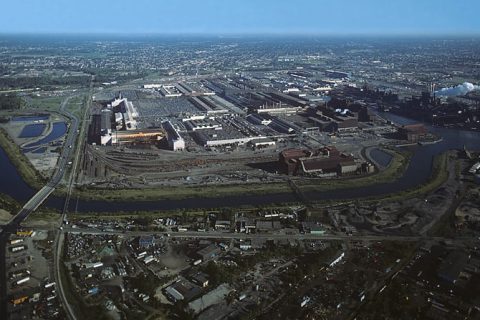
Ford Motor Company's River Rouge Plant appears in Detroit
When the auto industry in the U.S. was at its mightiest, Ford’s Rouge plant inhaled iron ore, coking coal and other raw ingredients at the front end and exhaled finished automobiles at the other.
Call it historical irony, but at Huron Valley Steel Corp., the goal is the opposite of Henry Ford’s ideal manufacturing process. For Huron, the disassembly line starts with a clunker and ends with newly poured aluminum ingots. Some of this secondary aluminum is bought by the auto industry’s die casters, whose molds bend sheet metal into car parts, thus starting the manufacturing loop again.
Sure, it resembles sustainable manufacturing, but the industry got there in fits and starts. Higher oil prices turned out to be a blessing. “The key is that for years, recycling was good,” says David Wallace, a Huron senior vice president. “Now it’s not only good, but it’s about energy too.” Smelting aluminum from bauxite requires enormous amounts of energy. Melting aluminum scrap, known in the industry as “twitch,” costs about a 10th as much because of its lower energy demand.
(See pictures of Detroit’s beautiful, horrible decline.)
In the U.S., the $22 billion car-recycling business, like cars themselves, continues to get more sophisticated. Today autos are designed for recycling, and a host of scavengers feast on the annual supply of 14 million car carcasses, harvesting everything from tires to base metals. In the past, junked cars were taken to landfills. Then, in the 1960s, companies like Huron began melting down the junk to produce pig iron. Huron then switched to aluminum, which was becoming an ever larger component of carmaking — and consequently more valuable. The focus on nonferrous allowed a rough-and-tumble business to gain an air of technological sophistication, even though it starts in a nasty-looking junkyard where a massive shredder reduces car bodies to metal confetti. “It’s become fashionable,” says Richard Wolanski, another Huron senior vice president. “It used to be known as scrap.”
(See the 50 worst cars of all time.)
Wolanski is one of the people who made it possible. A physicist and engineer, he was part of a team that designed and built Huron’s patented 60-in. (1.5 m) eddy-current rotor to separate metals. At a Huron facility near Detroit, shredded bits of metal ride a conveyor into a heavy-media stream, where ferrosilicon changes the specific gravity of water. Heavy metals, including zinc, copper and stainless steel, sink to the bottom. The aluminum floats. The twitch can also be sorted by a laser system that identifies specific alloys. That’s important, because specific aluminum alloys are sold to specific industries: for aircraft, construction or automobiles.
Much like the auto industry, the automobile-recycling game is cyclical. It was roaring through 2007 in large measure because of the unquenchable thirst of China for metal. Then, with the global financial crisis, it ground to a halt. But business has picked up enough so that Huron and its sister company Fritz Enterprises, which does the smelting to Huron’s specs, are planning to increase their aluminum output.
Having milked the metals, Huron’s research-and-development team is now looking at the nonmetal content of cars, called “fluff.” The idea is to take the rubber and plastics and other nonmetals and turn them into a fuel that can be converted to energy via gasification. Why? Because 22% to 25% of every auto consists of nonmetal parts, and that’s without the tires. “Originally we shredded the cars to get to the ferrous,” says Wallace. Then the company moved up the value chain to nonferrous. “So now the question is, How do we get the percentage that is nonmetallic?” Despite Detroit’s recent troubles, it is justly famous for pioneering methods of car manufacturing. What’s to say it can’t lead the way in demanufacturing too?